
By Staff Writer | for Moakanyi Magazine
According to the Africa Housing Finance Yearbook 2018, published by the Centre for Affordable Housing Finance in Africa, there is scope for growth and further development of the construction and real estate industry in Botswana.
The report details a lot of imperatives, one of them being “Housing Supply”. According to the 2011 Population and Housing Census, traditional housing units decreased from 64 percent to 13 percent of the total between 1991 and 2011. Most Batswana traditionally maintained three residences – in a village/city/town, at the “lands” (for arable agriculture) and at the cattle post; however, the core residence is in the villages or cities/towns. The type of housing structure is even changing at the lands and cattle post, mostly because of the durability of the materials used for a modern house.
According to the Population and Housing Census there were 550 846 housing units in Botswana in 2011. Out of these, 357 567 were in urban areas and 193 379 in rural areas. The average household size in Botswana has been declining over the years, from 5.5 in 1981 to 3.7 in 2011; many are single member households (27.8 percent). The Botswana Housing Corporation (BHC), established in 1971, is the primary housing developer in Botswana.
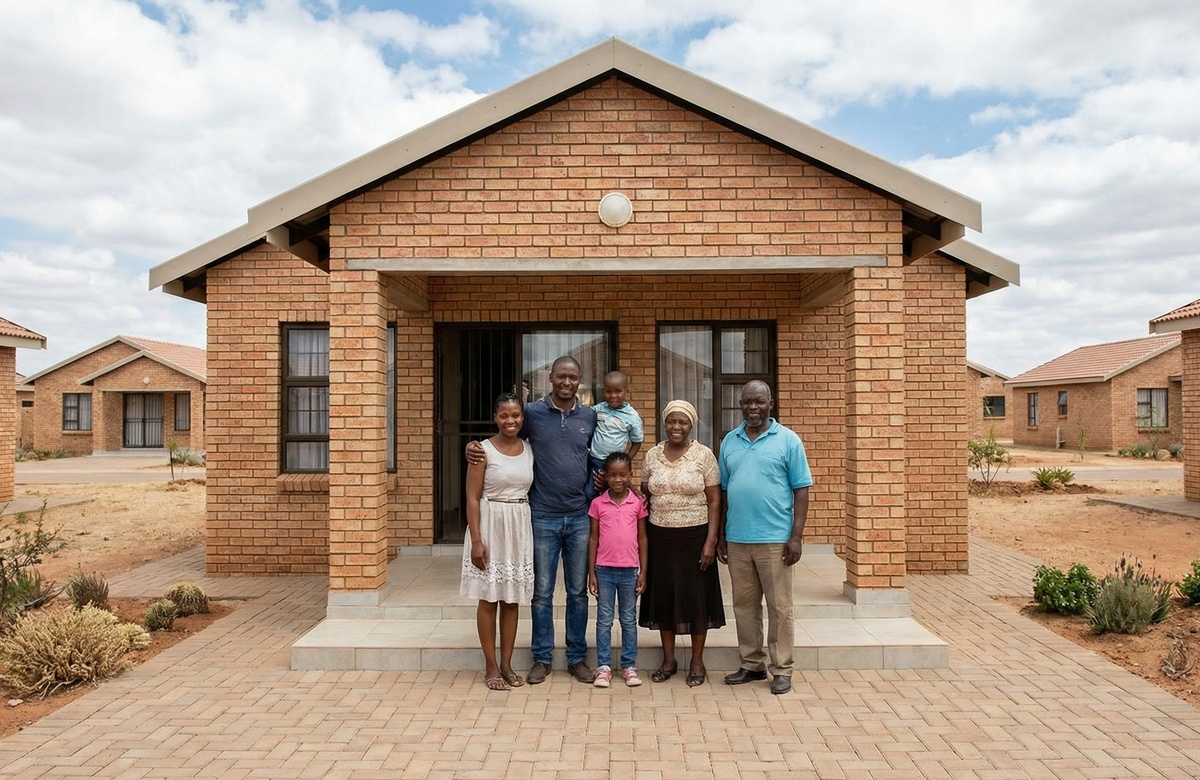
Historically it provided for the housing needs of government, local authorities and the general public by providing rental housing, although in recent years it has also been offering houses for sale. BHC has a large estate of flats and town houses, with a mix of high, medium and low-income houses spread throughout the country, with concentrations in Gaborone and Francistown. BHC’s smallest housing product is a 58m2 house on a plot of 400m2 or larger. Such a house would typically be priced from P600 000 (US$58 422) upwards. BHC suggests that the minimum mortgage instalment for such a house is P5 500 (US$536), which means that a household would have to earn at least P13 750 (approximately US$1 317) a month for this to be affordable – which would imply a household in the top 10 percent of the national income distribution.
The rentals charged by BHC for tenanted accommodation are subsidised – as a matter of government policy – but even so, BHC properties are still more suited to the formally employed than low income households. In April 2012, the BHC’s mandate was expanded to operate as government’s single housing authority. As a result, BHC is now also responsible for the construction of turnkey housing units and is in charge of implementing the POHI, the IPS and Youth Housing.
In 2017, a total of 1 924 houses were started by BHC and 1 889 delivered. The highest number of houses delivered was turnkey houses at 1 376 houses followed by POHI at 177. About 372 IPS houses were started in 2016, however, they have not been delivered. The IPS targets the youth and middle-income groups with monthly incomes of P3 000 (US$292.5) to P7 000 (US$682.5). Besides the BHC, few private sector developers are providing housing for sale. Indicative prices are that building costs for a 60m2 house would be between P4 000 and P5 000 a m2 (US$390-US$487), with a total cost of P240 000- P300 000 (US$23 414-US$29 268). The cost of land servicing (providing basic roads, water, electricity and water-borne sewerage connections) varies by location, but is typically in the range of P200-P300 (US$19.5-US$29.3) a m2. However, housing provision by private developers is typically aimed at upper middle- and high-income households, with incomes of P10 000 (US$975) a month or more.
Homeownership is important to Batswana, and the 2011 Census data shows that 57 percent of housing units were owner-occupied. Most of the remainder were rented privately, but approximately a quarter of rented accommodation was provided by government or its agencies. Land tenure in Botswana is divided into three types: (i) freehold; (ii) state land; and (iii) tribal land. Freehold land can be freely bought and sold (although with some restrictions on the purchase of freehold agricultural land by non-citizens). While state land and tribal land cannot be bought and sold, leasehold tenure is available. State land leases are freely marketable, while tribal land leases are generally only available to citizens. Every Botswana citizen is entitled to a residential plot on tribal land.
Such plots are available either free (for unserviced land) or at a heavily subsidised price (for serviced land); for instance, a serviced Self-Help Housing Agency plot in urban areas is sold for P15-P22 a m2, compared to a servicing cost of approximately P350 a m2. In addition, citizens are entitled to free land for agricultural purposes. This system means that there are very few, if any, landless Batswana. However, not all land is equal, and there is excess demand for subsidised residential plots in or around urban areas, especially close to Gaborone, whereas residential plots are readily available in smaller and more distant villages. Tribal Land is administered by statutory Land Boards. The (theoretical) availability of subsidised land means there are long waiting lists for tribal plots in peri-urban areas.
However, this does not necessarily represent genuine demand for housing plots, rather the fact that those who are lucky enough to obtain such plots can re-sell them at a substantial profit. In fact, many of land applications are for speculative purposes, where plots are sold once an allocation is made. In addition to the BHC, there are also private developers, the biggest being Premier Properties, Universal Estates, Sheldon Properties and Time Projects. For example, Time Projects reports that the company purchased 55ha of land in the early 1990s in the south of Gaborone and designed the residential suburb known as Kgale View thereon.4 The project was completed within budget and substantially ahead of schedule. Time Projects installed the infrastructure for 800 plots and constructed 400 houses purchased by government. Private sector housing was later developed on the remaining 400 plots.
The contribution of private developers to the supply of housing in Botswana is summarised by a 2013 study by University of Pretoria scholars, which concludes that the performance of private developers has been generally good with annual turnover of those companies interviewed averaging between P5 million (US$47 000) and P10 million (US$98 000).