
Property – Construction & Engineering · Editorial
By Moakanyi Magazine · China-in-Africa · June 2026
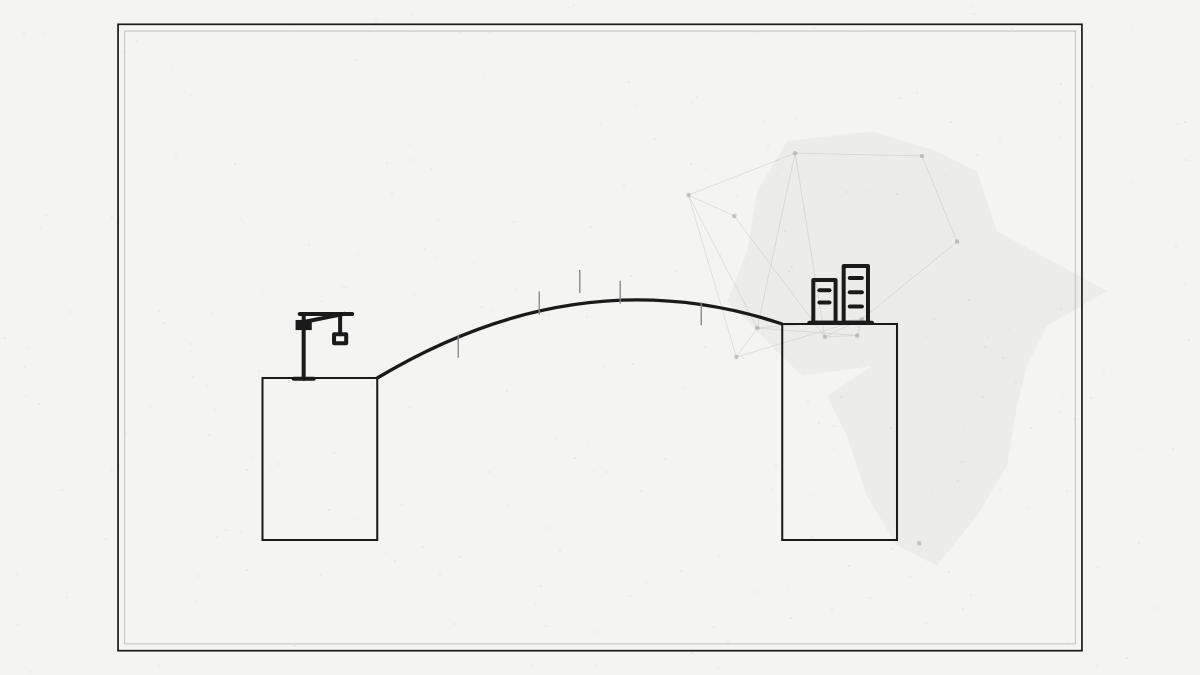
A bridge is the quietest infrastructure there is – no timetable, no operator, just a gap closed. The Maputo-Katembe bridge, at 3,041 metres the longest suspension bridge in Africa, replaced a slow ferry across Maputo Bay and turned a six-hour drive from the South African border into roughly 90 minutes. It is a textbook silent multiplier of everyday commerce. It is also Mozambique's most expensive project since independence, financed almost entirely by a Chinese loan – the multiplier and the millstone in one span.
The multiplier: a ferry replaced by a 90-minute drive
Before the bridge, Katembe was a ferry ride away from Maputo, and the road south toward South Africa's coast was a long detour. The China Road and Bridge Corporation span, opened in 2018 with a 680-metre clear suspension between 140-metre pylons and four lanes running 60 metres above the water, collapsed that distance. Projected daily traffic jumped from around 200 vehicles by boat to a forecast 4,000-plus, opening Katembe to development and shortening the southern trade and tourism route toward KwaZulu-Natal.
This is what makes bridges efficient development tools: a single short structure can redraw a city's geography overnight. Land on the far bank that was effectively remote becomes buildable; a regional route that ran half a day becomes an afternoon; trade that the bay suppressed becomes routine. The asset moves no goods itself, yet it changes the economics of every journey that crosses it. The bridge replaced the Matadi Bridge in the Democratic Republic of Congo as the continent's longest of its kind, a marker of how far Chinese bridge engineering had moved into Africa by the late 2010s.
A bridge moves no goods itself; it simply lets everything else move faster.
The bill: US$785m at 4%, repaid by the state
The multiplier was bought on credit. China Exim Bank financed about 95% of the roughly US$785m cost through 20-year loans at 4% interest, with the Mozambican state on the hook for repayment – a heavy commitment for one of the world's lower-income economies. To service it, the bridge charges tolls ranging from about US$2.60 to US$20 a crossing, with discounts for frequent users, in a country where many cannot easily absorb the fee.
That is where the contestation sits. Critics argued the tolls would barely cover upkeep while pricing poorer residents out of their own suburb – one Mozambican commentator noting the fees seemed aimed at maintenance rather than recovering the investment, another arguing the bridge widened inequality by erecting a financial barrier across a crossing that had been cheap. A structure built to connect can, through its financing, also divide the people it connects. The arithmetic is stark: a journey that once cost as little as a few cents by boat can now run to US$20 by car across the same water.
The cheapest way to cross the bay is now closed to those who once crossed it cheapest.
The pattern: small structures, outsized consequences
China's foreign ministry counts nearly 1,000 bridges built across Africa, and the Maputo span shows why each matters more than its length suggests. A single structure can redraw a city's geography, reroute regional trade and reset land values – the outsized return that makes bridges among the most cost-effective infrastructure a government can commission. It can also, as here, lock a state into two decades of fixed-rate repayment for an asset whose tolls fall hardest on the residents it was meant to serve.
Read across a thousand such structures, the pattern is the China-Africa bargain in miniature: real, durable assets that genuinely raise the ceiling on commerce, delivered through loans whose terms outlast the ribbon-cutting by twenty years. The engineering is rarely the contested part. The financing almost always is – and a bridge, because it is so visibly useful, makes the trade-off easier to wave through and harder to walk back.
Bridges multiply commerce and debt by the same arithmetic.
The southern corridor is where the wider meaning sits. By cutting the drive from the South African border to Maputo from about six hours to 90 minutes, the bridge does not just serve a city – it shortens a regional artery toward KwaZulu-Natal, with implications for cross-border tourism and trade that reach well beyond Mozambique. That is the continental pattern in a single span: a national asset, locally contested over its tolls, that quietly rewires how an entire sub-region connects to its largest neighbour – and ties the country servicing the loan to a route others will use freely.
The Maputo-Katembe bridge is a real gain – shorter journeys, new development on the far bank, a working southern corridor toward South Africa. It is also a clean illustration of the bargain beneath much of China-Africa infrastructure: a genuine multiplier of everyday commerce, delivered on a loan that someone, eventually, at 4% interest, has to repay – and tolls that decide who gets to enjoy the multiplier in the meantime.
Sources: Maputo-Katembe bridge – Wikipedia, Maputo-KaTembe bridge tolls and debt – Global Voices, China MFA – China-Africa cooperation