
Intellectual – Foresight & Big Ideas · Editorial
By Moakanyi Magazine · Global Issue · June 2026
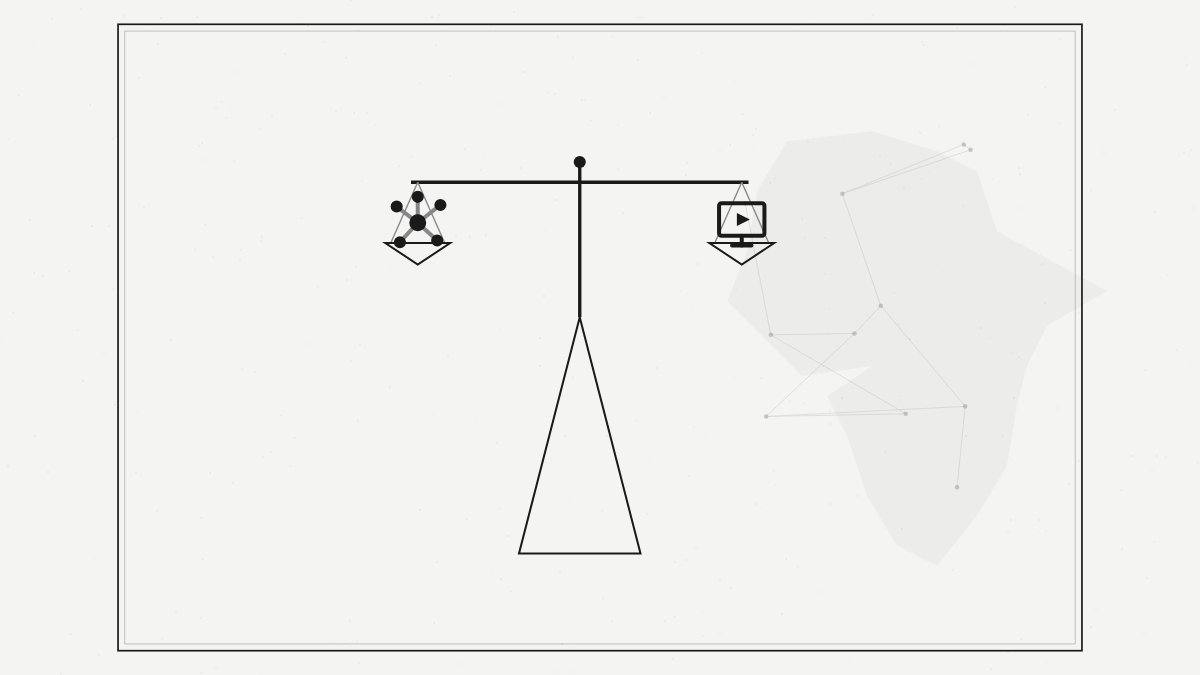
A technology that promises to lift everyone tends, at first, to lift those already standing on something. Recent research on AI-driven trade, set out in a working paper on how AI reshapes commerce, points to a growth dividend that does not land evenly. It accrues to markets that already have the four things AI quietly assumes: reliable power, devices in people's hands, the skills to use them, and the connectivity to join everything up. Where any of those is thin, the dividend thins with it. The result is an access divide running underneath the headline of AI-led trade growth – a divide that decides who captures the gain and who merely reads about it.
For Botswana, the useful move is to read the divide as a checklist rather than a sentence. Each of the four inputs is something the country can measure today and build over time. None is set in a foreign capital. The technology is exogenous and moving fast, but the floor that decides who benefits from it is local, concrete and within reach – which is exactly why it deserves the attention the tools themselves tend to monopolise.
Power and devices: the physical floor
The first two inputs are stubbornly physical. AI services run on electricity and reach people through devices. A market with unreliable power or low device penetration cannot capture much of an AI-driven trade gain, however clever the software, because the floor it stands on is uneven. This is the least glamorous part of the divide and the most decisive – no amount of sophistication upstream compensates for a screen that is dark or a phone that nobody owns.
For Botswana, that points attention at the unspectacular work of stable electricity supply and affordable devices – in Gaborone, but more pointedly in Maun, Kasane, Selebi-Phikwe and the smaller centres where the floor is thinnest. The temptation in any AI conversation is to skip to the applications. The discipline is to ask first whether the power and the handsets are there to run them, because that is where the divide is widest and the gains are most easily forfeited.
AI runs on electricity and reaches people through devices, or it does not reach them at all.
Skills and connectivity: the human floor
The second pair is human and network. Skills decide whether a firm can put AI tools to work rather than merely buy them, and connectivity decides whether those tools reach beyond the capital. A trader who can use AI to find buyers, price goods and clear logistics captures the dividend; one without the skills or the bandwidth watches it pass. The divide here is as much about training colleges and broadband rollout as it is about the technology itself, and both are slow to build and hard to import.
Botswana's path runs through digital-skills programmes and the steady extension of connectivity beyond Gaborone into the rural and tourism economies. These are levers the country holds directly, even as the underlying technology is designed elsewhere. A firm in Kasane with the skills and the connection competes on the same AI terms as one in a larger market; the same firm without them is locked out regardless of how cheap the tools become.
The dividend goes to those who can use the tool, not those who merely own it.
Turning a divide into a plan
Naming the four inputs converts a worry into a sequence. AI-driven trade growth rewards markets with power, devices, skills and connectivity; Botswana can audit itself honestly against each and invest where the gap is widest rather than where the conversation is loudest. The divide is not destiny. It is a description of what has to be in place before the technology pays, and therefore a map of where to start and in what order.
Read that way, the access divide is less a warning than a work plan. It tells a planner that the AI question and the infrastructure question are the same question, and that the country which quietly fixes its floor will be positioned for the dividend long before the one chasing the latest tool. The unglamorous inputs are the strategic ones.
An access divide is a checklist before it is a verdict.
The so-what for Botswana is that the AI conversation should stay grounded in the four enablers rather than the tools themselves. A country that builds reliable power, gets devices into hands, trains its people and extends connectivity is positioning to be on the gaining side of AI-led trade growth – regardless of which model or application leads next year. The technology is global and exogenous; the floor that decides who benefits is local and buildable, and Botswana's task is to build it before the dividend it unlocks has already been claimed elsewhere.
Sources: arXiv