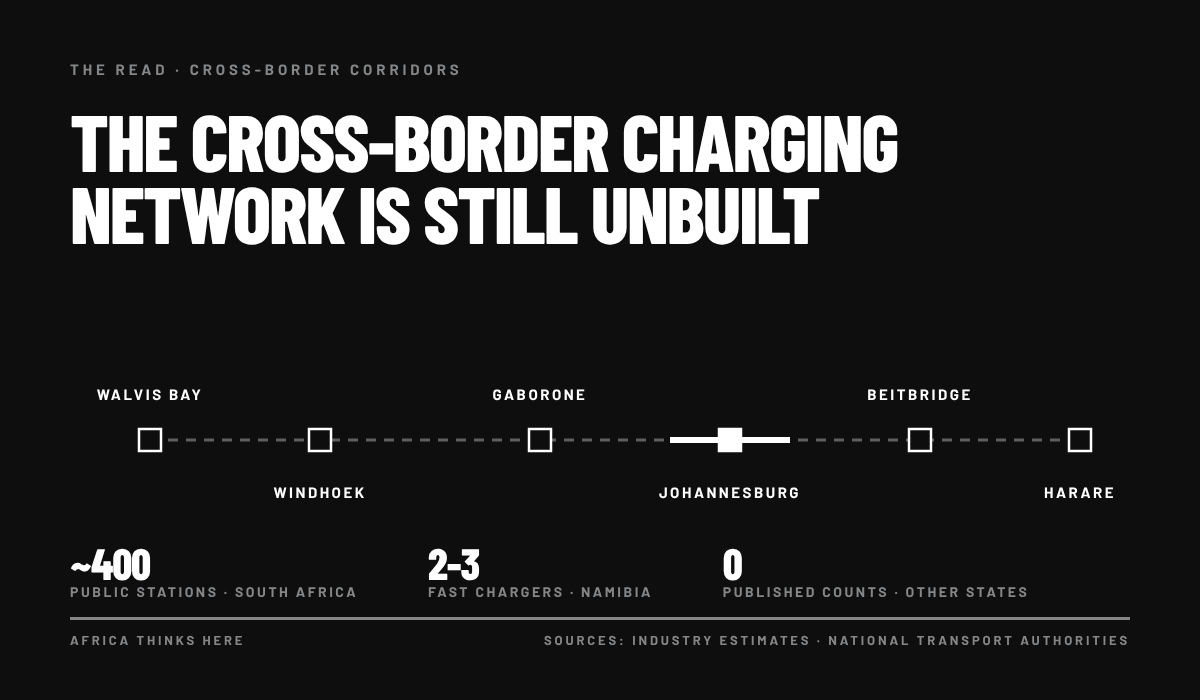
The region’s trade runs on corridors – Walvis Bay to Gaborone across the Kalahari, Johannesburg to Harare through Beitbridge, Lusaka to the coast. Its electric vehicles, though, are confined to the cities where they were bought. No published data shows a charging network covering any of these corridors across a border.
The ground. The evidence is the absence of evidence:
- South Africa reports about 400 public charging stations, concentrated in its metros and on a handful of national roads.
- Namibia has fewer than 200 electric vehicles and, by industry estimates, two or three chargers faster than a household socket. The City of Windhoek has moved to regulate electric vehicle charging as rising fuel prices push residents to switch.
- Botswana has nearly 500 registered electric vehicles and an assembly plant in Gaborone that has produced 68, but no published charger count.
- Zimbabwe, Zambia, Mozambique and Malawi publish none either.
The mechanism. Cross-border charging fails for a structural reason, not a technical one. Each country’s charging, where it exists, is built by local operators, billed in local currency and accessed through local apps. A driver crossing from South Africa into Botswana leaves one network and enters – at best – another that does not recognise their account, cannot bill their card in rand and does not appear in their app.
The rest of the world solved this with roaming. Networks agree to recognise each other’s drivers, and a common protocol, OCPI, maintained by the EVRoaming Foundation, carries the authorisations and settlements between them. A driver on one network charges on another and is billed once, at home. It works the way mobile phone roaming did in Southern Africa twenty years ago. Nothing about the region’s geography prevents it. What is missing is an operator – or an alliance – willing to sign up sites on both sides of each border and take payment in every currency on the route.
The consequence. For the businesses along the corridors, this is an unclaimed position. Fuel stations, lodges, border-town hotels and truck stops already have power, parking and a reason for travellers to stop. A charger turns a 20-minute fuel stop into a 45-minute meal and a sale. Electric vehicles on the corridor are still few today. That keeps entry cheap, and it means the sites signed now become the network’s fixed points before competitors arrive.
The electric bus is the lead indicator. Maputo has its first electric bus, with ten more being prepared, and Mauritius has 106. Buses and freight fleets run fixed routes, and they will need corridor charging long before private drivers do. A network that serves fleets on day one does not depend on private adoption to fill its chargers.
The decisive close. The cross-border corridor is the one charging market in Southern Africa that cannot be won city by city. It will go to the operator that builds the network across borders from the start – multi-currency, roaming-ready, and signed up with the stops travellers already use. The corridor is open now, and it will not stay open.
Sources
- Wikipedia – Plug-in electric vehicles in South Africa
- CarYange – Namibia EV market slow uptake
- New Era – Windhoek moves to regulate EV charging
- Africa News Analysis – Botswana’s EV ambitions
- EVRoaming Foundation – OCPI
- Club of Mozambique – MetroBus electric bus fleet
- allAfrica – Mauritius electric bus fleet reaches 106