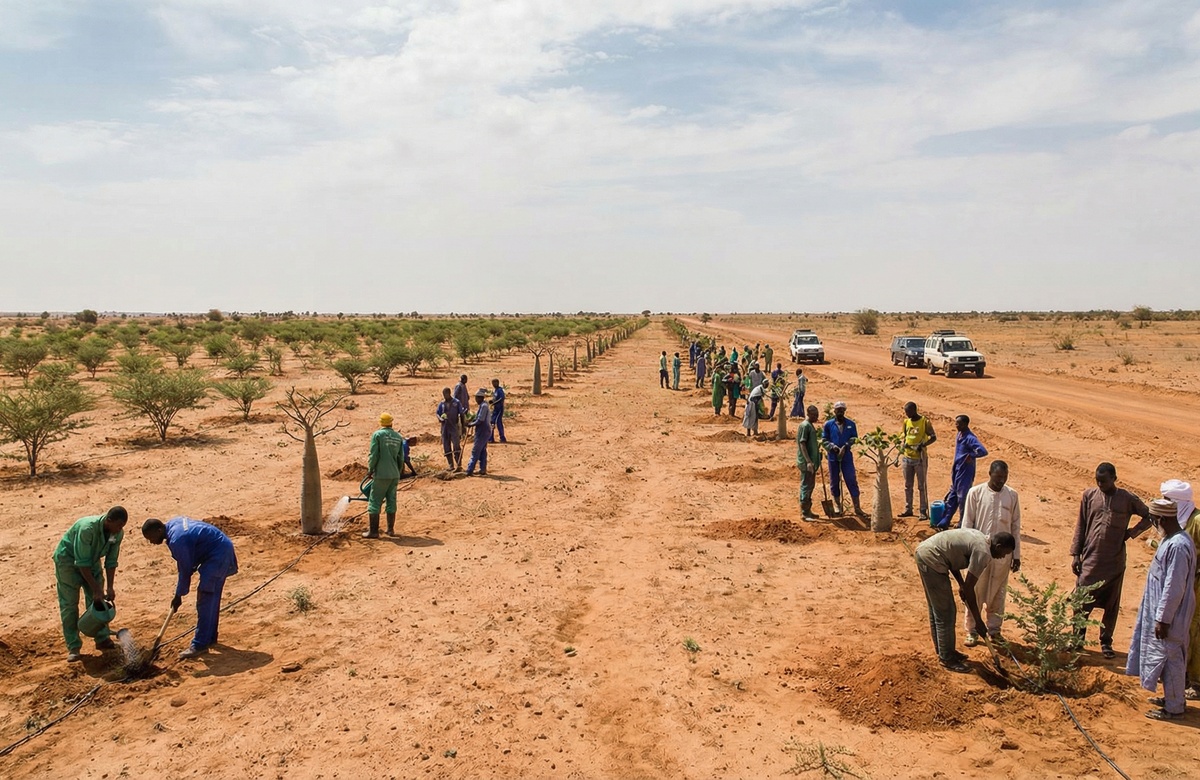

A decade in and roughly 15% underway, the initiative is already bringing life back to Africa’s degraded landscapes at an unprecedented scale, providing food security, jobs and a reason to stay for the millions who live along its path.
The Wall promises to be a compelling solution to the many urgent threats not only facing the African Continent, but the global community as a whole – notably climate change, drought, famine, conflict and migration.
Once complete, the Great Green Wall will be the largest living structure on the planet, 3 times the size of the Great Barrier Reef.
y 2030, the Wall aims to restore 100 million hectares of currently degraded land, sequester 250 million tonnes of carbon and create 10 million jobs in rural areas.
The Great Green Wall contributes directly to the 2030 UN Sustainable Development Goals. These 17 Goals adopted by world leaders aim to end poverty, promote prosperity and well-being for all, and protect the planet.
It all started when…
In 2015, world leaders agreed to 17 goals for a better world by 2030. These goals have the power to end poverty, fight inequality and stop climate change. Guided by these goals, it is now up to all of us, governments, businesses, civil society and the general public to work together to build a better future for everyone.
The Great Green Wall supports an astonishing 15 of the 17 Sustainable Development Goals.
Growing a green wall across the Sahel does much more than just restore degraded land. This extraordinary initiative fights poverty and hunger, builds local resilience to climate change, improves health and well-being, creates jobs, boosts economic opportunities and much much more.
It’s up to us all to become leaders and support communities along the Wall in achieving
this urgent and epic dream. Join a growing movement of people around the world who are
working to help grow the Great Green Wall .
JOIN THE MOVEMENT
Growing an 8000km world wonder across Africa is not a foregone conclusion.
10 million hectares of degraded land need to be restored every year from now until 2030.
We need collective action from global citizens around the world to help power this urgent movement, and create a unique and lasting legacy for all humanity.
THE CHALLENGE
The catalyst for the Great Green Wall is the daily impact of desertification and climate change that is undermining the futures of millions of communities across Africa’s Sahel region.
Since the 1970s, the Sahel has been heavily affected by recurrent periods of drought. These droughts have threatened the livelihoods and future of entire populations across the region.
The lack of rain has led to the disappearance of livestock and the destruction of cereal crops. The great famines that rocked the Sub-Saharan region in the 80s each affected millions of people. In addition, the high population growth rate is increasing demand for food and pressure to gain access to other natural resources which are the basis for livelihoods and the survival of the rural population.
Millions of people – particularly rural youth – are currently facing an uncertain future due to the lack of decent rural jobs and continuous loss of livelihoods due to land degradation and falling yields.
If we don’t act, frustrations will boil over with more migration and more conflict over a shriveling resource base.
Africa’s Sahel region is the crucible for some of humanity’s most pressing challenges. The rapid degradation of the natural environment is a key driver. Here are some of the alarming statistics in the Sahel today:
46% of African land is degraded, jeopardizing the livelihoods of nearly two-thirds of the Continent’s population.
20 million people in the Horn of Africa in 2017 declared on the verge of starvation following severe drought and food crises
Millions are expected to migrate from degraded parts of Africa in the next two decades
100 million population of the Sahel is expected to grow to 340 million by 2050
200 million of the 375 million young people entering the job market over the next 15 years will be living in rural areas.