The instinct when a cleaning job looks too big is to throw more people at it. It rarely works on its own, because a crew without a named owner does not divide the work so much as blur it. Four people who each assume someone else has done the stairwell will leave the stairwell undone, and every one of them will be able to say, honestly, that it was not their job. The problem on a large clean is seldom too few hands. It is that no single hand is answerable for the result.
Botswana is meeting this question more often as the work around buildings gets more organised. DailyNews reported that facilities management is growing here as organisations focus on operational efficiency and the upkeep of their assets, and at the World Facilities Management Day event in Gaborone on 15 May 2025 the president of Botswana Facilities Management, Mr Michael Mafa, described how the field had helped service providers win larger contracts and place young professionals into structured roles. Larger contracts mean larger teams, and larger teams are exactly where accountability leaks away unless someone is put in charge of it on purpose.
Why more people can mean less control
A one-person clean has a built-in advantage: there is nobody to blame but the cleaner, and nobody for the client to phone but her. The moment a job needs three or four people – a deep clean before an office reopens, a monthly clean of a large retail floor, a body-corporate common area – that clarity disappears unless it is rebuilt deliberately. Instructions given to “the team” are heard by everyone and owned by no one. Standards drift because there is no one on site whose reputation rides on the final walk-through. And the client ends up managing the crew directly, which is the very burden they were trying to hand over.
What one person in charge actually does
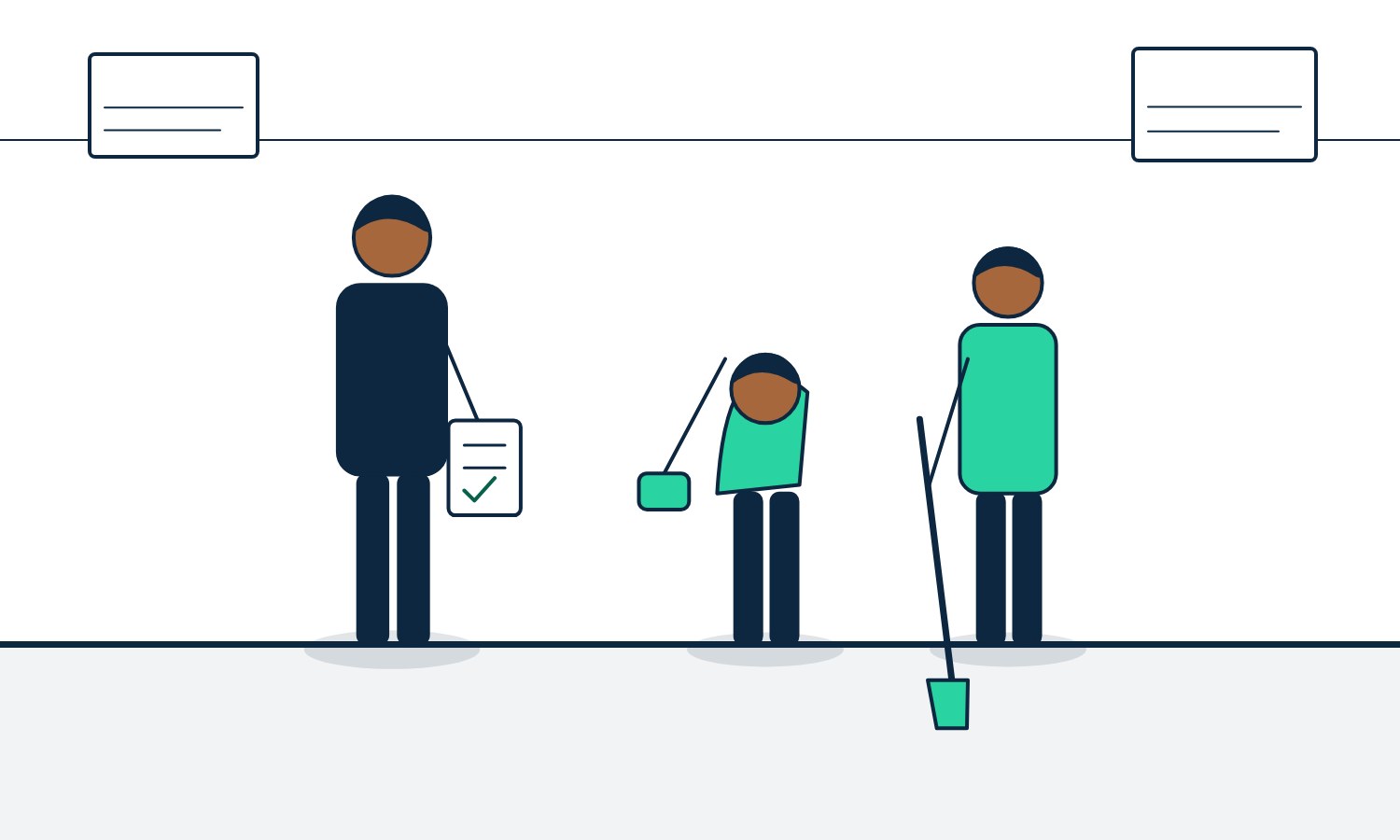
Putting someone in charge is not about hierarchy for its own sake. It is a set of concrete jobs. A named lead splits the site into zones and assigns them, so every square metre has an owner. She sets the sequence and the standard, checks the work before anyone leaves, and carries the equipment and materials list so nothing is discovered missing halfway through. Above all, she is the one person the client speaks to – a single point of contact for the brief at the start, the questions in the middle, and the sign-off at the end. The commercial cleaner The Specialists makes a related point about its own structure, noting that every branch is owner-run so that a named person, not an anonymous roster, stands behind the service.
This is also the shape a good introduction platform gives a crew job. On Kleana, which operates in Botswana, South Africa, Zimbabwe and Zambia, a project is not a loose pool of workers but an assembled and managed crew with one lead as the client’s point of contact. The client scopes the work once, to one person; that person carries it to the team. It is deliberately unlike hiring four separate cleaners for the same morning and hoping they coordinate themselves. The mechanism is simply that responsibility is assigned to a name before the first bucket is filled, not reconstructed afterwards when something has been missed.
What changes when someone owns it
For the client, the difference is felt as calm. There is one number to call, one person to hold to the standard, and one walk-through at the end where the job is either accepted or listed for correction. Disputes shrink because they are no longer “the team missed this” but “this zone was signed off and it should not have been”, which is a conversation a named lead can actually answer. For the crew, the effect is fairer than it sounds: work is distributed openly, credit and correction land where they are due, and no one carries the whole site while another coasts. The lead earns her role by being answerable, and the members are judged on their zones rather than a vague collective impression.
The arrangement also protects the cleaners from the client. On a leaderless job it is the client who ends up issuing corrections directly, often to whoever happens to be nearest, which is how a fair instruction curdles into the feeling of being watched and blamed. A named lead absorbs that. Corrections go to her, she decides how to reallocate the work, and the members deal with one familiar voice rather than a nervous employer standing over them. It is a small dignity, but it is the kind the professional charter behind a platform introduction is meant to protect: the engagement is work, the terms and the chain of instruction are settled up front, and nobody is left guessing who they answer to.
There is a cost, and it should be named. One person in charge is one person to pay for the coordination, and the rate reflects it. But the alternative is not free; it is simply paid in re-cleans, arguments, and the client’s own time spent supervising strangers. A large job managed by nobody is usually more expensive than a large job managed by someone, once the missed corners and the return visits are counted.
Give every project one owner
The decisive move is to refuse the false economy of a leaderless crew. Whenever a clean needs more than one pair of hands, insist that one of them is in charge – named, briefed, and accountable for the whole result, not just her own zone. Ask, before the work starts, who that person is and how you reach her. If the answer is “the team”, you do not have a project; you have a crowd on your premises. Put a name to it, and the job becomes something you can hold, correct and trust.
Source: Kleana Africa – kleana.africa