
Economics – Macro & Markets · Editorial
By Moakanyi Magazine · June 2026
Four months after a budget banked on a rebound, the rebound had not arrived. In June 2025, permanent secretary Tshokologo Alex Kganetsano warned that Botswana's economy could register almost no growth for the year, as diamond revenue plunged and the fiscal deficit widened.
It was a recalibration in plain language. The February projection of 3.3% had assumed a diamond market that did not show up. The June assessment described the consequence, and did so early enough to count as a planning signal rather than a post-mortem.
The Gap: Forecast Meets the Market
The distance between a budget number and a mid-year warning is where commodity risk becomes visible. Botswana's revenue base leans heavily on diamonds, so a prolonged downturn in the rough market translates almost directly into thinner state coffers. When the inflow shrinks, the deficit does the widening. There is little cushion in between, because the economy lacks a second export of comparable scale to absorb the shock the way a more diversified producer might.
Kganetsano's caution that growth could be near zero was not a forecast of collapse. It was an acknowledgement that the recovery the budget needed had stalled, and that the gap would have to be managed rather than wished away. The word prolonged is the load-bearing one: a short dip can be ridden out on reserves, but a downturn that extends across sales cycles forces the harder choices about spending and borrowing onto the table.
A mid-year warning is the market correcting the budget's optimism.
The Mechanics: Revenue Down, Deficit Up
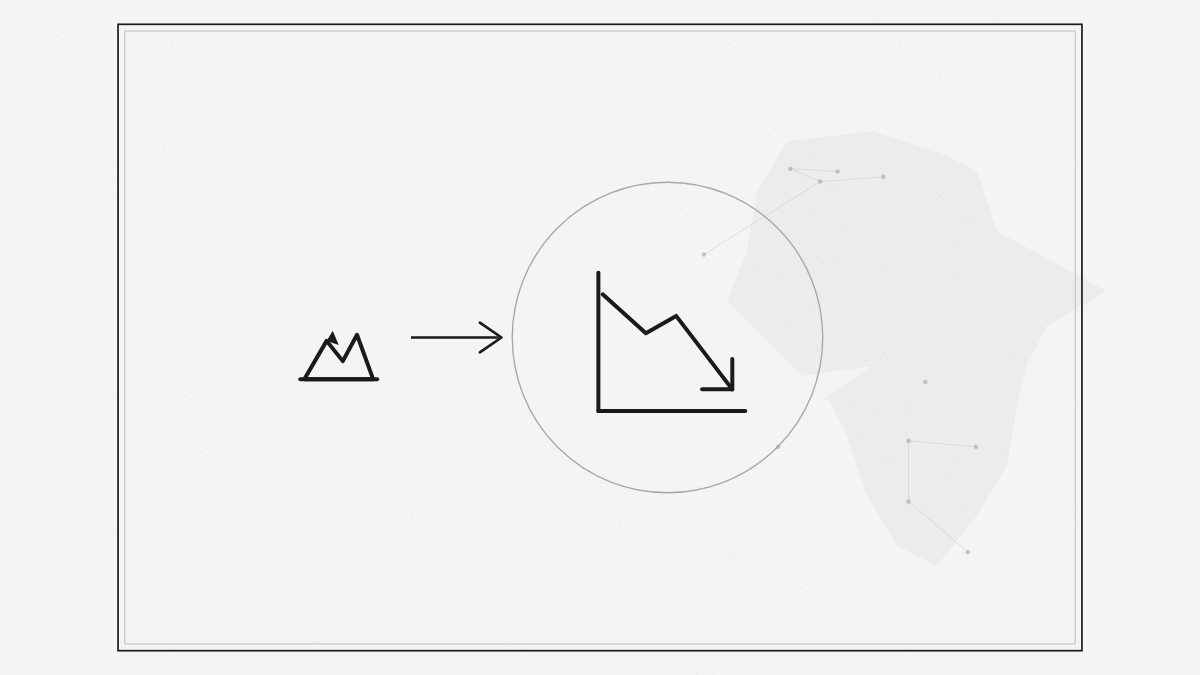
The two movements travel together. As diamond revenue falls, the shortfall between what the state spends and what it earns grows, and a widening deficit narrows the room for the very infrastructure and social spending that budgets promise. The arithmetic is unforgiving and familiar to any economy built on a single export, from oil producers to copper belts: the commodity giveth in the upcycle and taketh in the down, and the public balance sheet keeps the score.
Botswana enters such episodes with more defences than most, a long record of prudent fiscal management and accumulated reserves that have historically smoothed exactly this kind of shock. But reserves are a buffer, not a substitute for revenue, and every Pula drawn to cover a deficit is a Pula not available for the next one. The June warning was, in part, a signal that the buffer was being asked to work, and that the work would continue if the rough market stayed soft.
When revenue and the deficit move in opposite directions, the squeeze is already underway.
The Operator's Read: Plan for the Slow Case
For decision-makers, the signal in June was about sequencing. The fiscal year still had months to run, and a near-zero growth path implied tighter choices ahead rather than a single dramatic adjustment. Businesses that depend on government as a customer, in construction, supplies and services, had reason to expect procurement to tighten and payment timelines to lengthen as the state guarded its cash position.
The wider lesson is about cadence. A concentrated economy does not move from forecast to outcome in one step; it issues a stream of warnings, and the operators who treat each as data rather than noise are the ones who adjust early. The June statement was the first formal admission that 2025 would not match its budget, and reading it as such was worth more than waiting for the year-end confirmation.
The firms that plan for the slow case are the ones the slow case does not surprise.
The June warning marked the moment Botswana's 2025 story shifted from aspiration to management. The diamond downturn had outlasted the budget's assumptions, and the question was no longer whether 3.3% was achievable but how much of the year could be salvaged. It was a reminder, delivered without drama, that a concentrated economy spends much of its time waiting on a market it cannot schedule, and that the discipline of governing through that wait is its own kind of test.
Sources: Reuters